































Key Insights
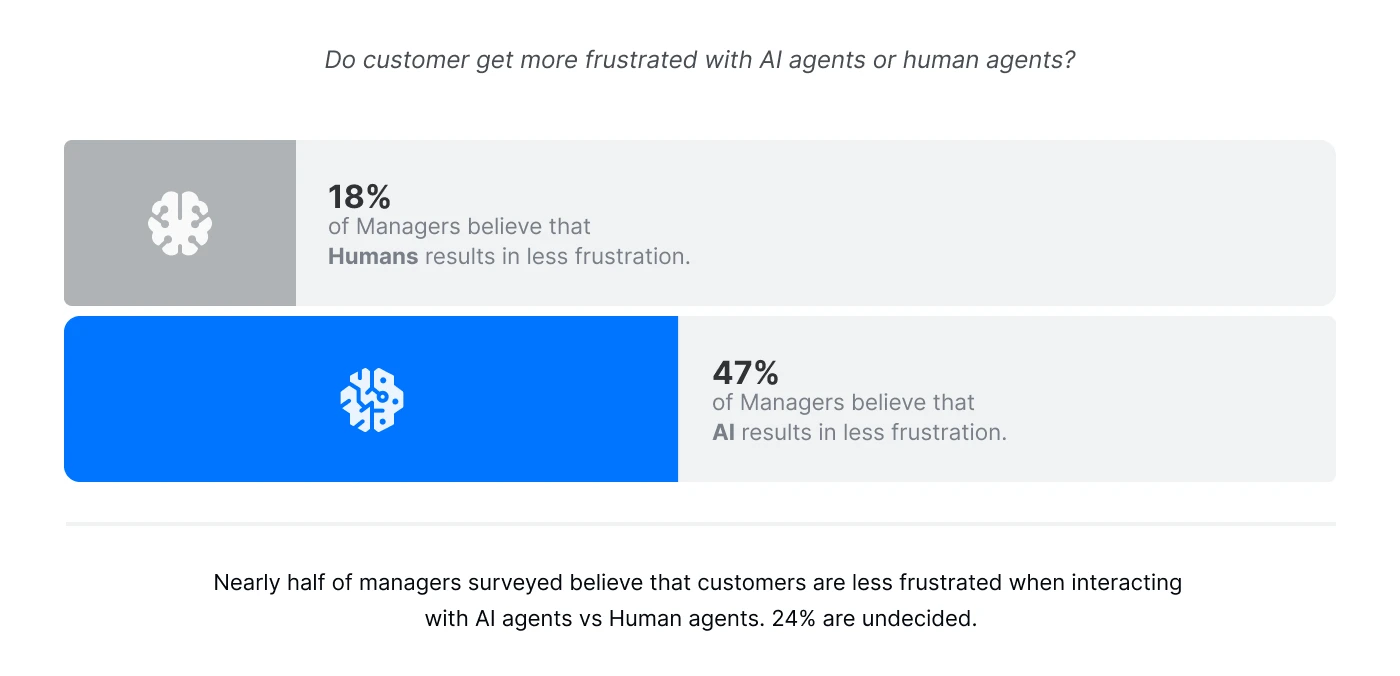
- 47% of managers say AI reduces customer frustration due to faster response times—yet 29% disagree, showing that efficiency alone doesn’t guarantee satisfaction.
- Managers are divided: 40% believe customers prefer AI-driven service, while 39% say humans still come out on top.
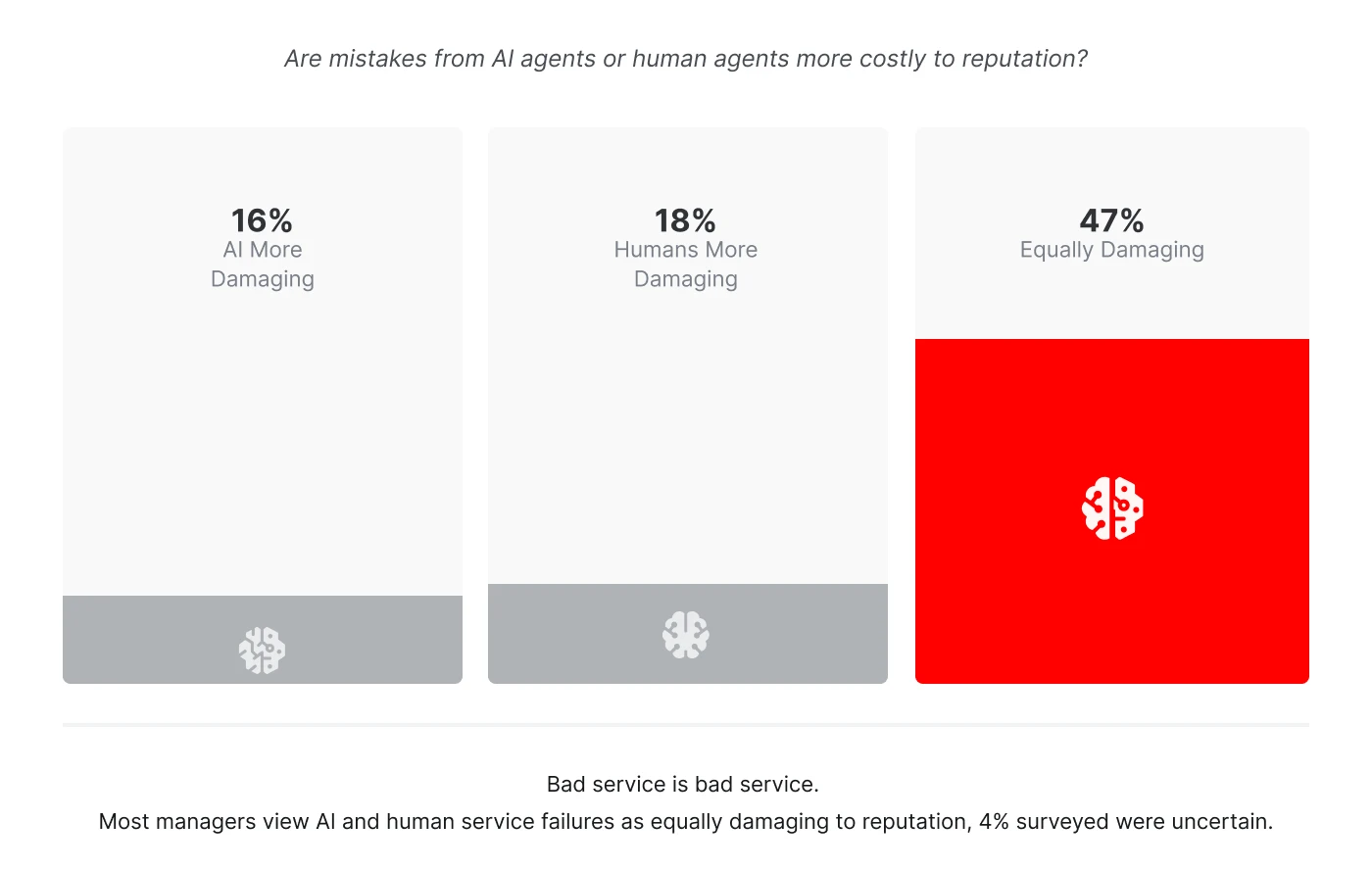
- 62% say both AI and human service failures are equally damaging to a brand—bad experience is bad experience, no matter who delivers it.
- 38% believe customers are more forgiving of human errors, compared to 29% who say AI mistakes get a pass, suggesting emotional expectations still favor people.
- 59% believe agentic AI can outperform humans in customer experience—but most still see it as part of a combined service model.
- 76% say transparency about AI use builds customer trust, making honesty a clear brand advantage.
- 68% warn that too much AI and not enough human touch will cost brands long-term loyalty.
- 74% believe AI and human agents working together deliver the best customer experiences, reinforcing collaboration—not replacement—as the future of service.
- 79% say AI still requires significant human support hours, challenging the idea that AI reduces labor needs.
- 52% report AI adoption has been more expensive than expected, revealing hidden costs in training, integration, and oversight—despite 64% calling AI a top strategic investment.
Introduction
Artificial intelligence has rapidly shifted from experimentation to execution inside modern businesses, and nowhere is this transformation more visible—or more scrutinized—than in customer experience. In 2025, customers expect fast, accurate, personalized service, yet they still value empathy and human connection.
Companies are racing to implement AI-powered service tools—chatbots, virtual assistants, voice AI, and automated decision systems—to scale support and reduce costs. But as AI enters the frontlines of customer interaction, it also raises a critical question: does automation strengthen or weaken customer trust?
To better understand this shift, Vida.io surveyed 2,000 U.S. managers who have direct experience using AI in the workplace. These respondents represent organizations actively exploring or deploying AI across teams and workflows, including customer experience operations.
Their perspectives offer an inside look at how AI is reshaping service models, team structures, decision-making, and brand reputation—revealing both optimism and concern. While many managers see AI as a competitive advantage, others worry about the cost of moving too quickly: customer alienation, employee resistance, data privacy risks, and the erosion of brand authenticity.
Vida.io commissioned this study to help businesses navigate the realities—not just the promises—of AI in customer experience. As a platform built to help companies understand customer behavior using AI ethically and effectively, Vida.io is committed to shining a light on the tradeoffs leaders face when integrating AI into service strategies. This report explores the tension between automation and human connection, revealing where AI delivers meaningful value—and where human agents still matter most.
This report is organized into four key sections:
- First, we examine the evolving role of AI in customer experience, including how service teams balance AI agents and human agents.
- Next, we assess brand reputation and customer trust in the age of AI, highlighting how managers believe AI affects loyalty and brand perception.
- Third, we explore AI’s impact on the workplace, uncovering how AI is changing team dynamics, productivity, hiring, and employee morale.
- Finally, we analyze cost, benefit, and ROI expectations, revealing what managers really believe AI will deliver for the business—and what it will cost to get there.
Together, these insights uncover the truth about AI in customer experience: companies may be adopting AI faster than ever, but long-term success will depend on how well they balance technology with humanity.
The New Customer Standard
AI may speed up service—but customers still judge brands by emotion, not automation
Artificial intelligence has moved to the front lines of customer experience. From automated chat to AI voice assistants and agentic AI systems that now handle full service workflows, companies increasingly rely on these tools to scale faster, respond quicker, and operate more efficiently. But while AI may improve service speed, the customer experience is ultimately emotional—and emotions are influenced by trust, empathy, and perception. This section explores how managers view the impact of AI on their customer interactions in 2025, including where AI creates value, where it creates risk, and when human support still matters most.
For businesses, the findings here make one thing clear: adopting AI in service isn’t enough. Success depends on how well companies blend AI efficiency with human empathy. The data below uncovers how managers interpret customer sentiment today—and what companies need to consider as they scale AI-powered service in a world where expectations for both speed and authenticity are rising.
Efficiency Matters—But It Isn’t Everything
Nearly half of managers (47%) believe customers become less frustrated when interacting with AI because of its speed and efficiency. Yet nearly a third (29%) disagree, making it clear that faster responses don’t automatically mean better experiences.
And when asked whether customers actually prefer AI over humans, managers were almost evenly split—40% said yes while 39% said no, with the rest undecided.
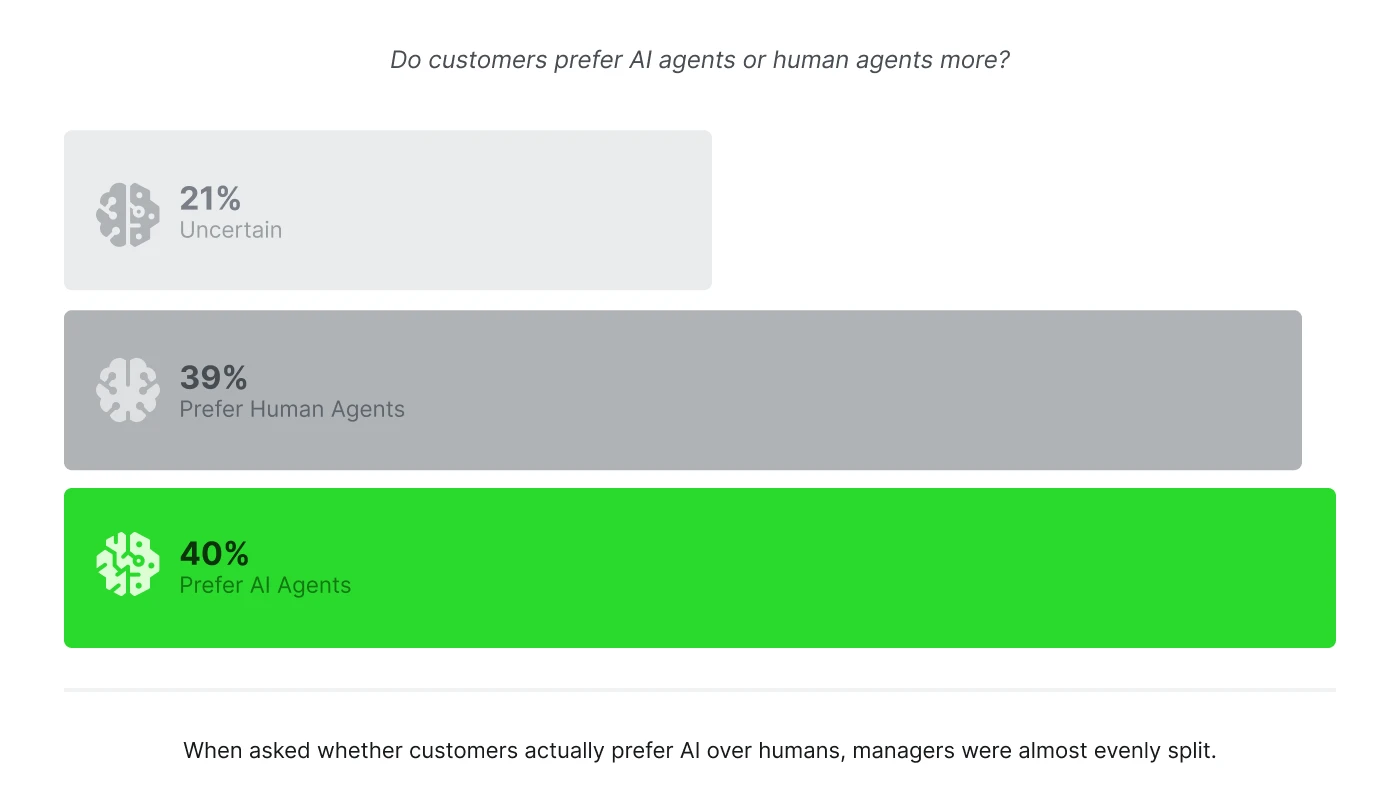
The takeaway: efficiency alone won’t win customer loyalty. Customers may accept AI—but they don’t necessarily prefer it, especially when emotional context or nuance is needed.
Reputation Is On The Line—For Both AI and Humans
When it comes to brand risk, managers overwhelmingly agree that bad service is bad service—no matter who delivers it. A full 62% said both AI and human service failures are equally damaging to a company’s reputation, while only 18% blamed human agents more and 16% blamed AI agents more.
But who gets more grace when mistakes happen? Managers say customers are still more forgiving of humans. 38% believe customers are more understanding of human error, while 29% say AI gets a pass because it’s “still learning.”
However, 15% believe customers aren’t very forgiving of mistakes from either side, raising the stakes for service quality across all channels.
AI Agents Are Here to Stay—But They Won’t Be Working Alone
Agentic AI—AI systems that can complete full service interactions without handoff—is gaining traction. 59% of managers now believe AI agents can deliver more effective customer service than humans alone. But even among AI supporters, most believe success will depend on partnership, not replacement—a theme echoed repeatedly throughout this study.
Customer service is no longer a simple choice between AI or humans. The future belongs to brands that combine AI efficiency with human empathy, using automation to enhance—not erase—the human experience.
Companies that move too far in either direction risk losing customers: go fully human and you fall behind on speed and scale; go fully AI and your brand feels impersonal and transactional.
The Trust Threshold
AI doesn’t break brands—bad AI does, and customers expect honesty now more than ever
As AI becomes more deeply embedded in customer experience strategies, it’s no longer viewed purely as a technology decision—it’s now a brand decision. The way a company uses AI signals what it values: efficiency, innovation, transparency, or human connection.
This section explores how managers believe AI is influencing brand trust and customer loyalty, and what companies risk when they automate too aggressively or communicate too little.
A strong theme emerged from the survey: customers don’t necessarily distrust AI, but they do distrust brands that use it poorly or deceptively. AI can enhance a company’s reputation—but only if implemented with honesty, clarity, and respect for the human experience.
Transparency Builds Trust
Nearly eight in ten managers (76%) said customers are more likely to trust a company that is transparent about using AI in customer interactions. This indicates customers don’t mind AI involvement, but they want to know when they’re engaging with it.
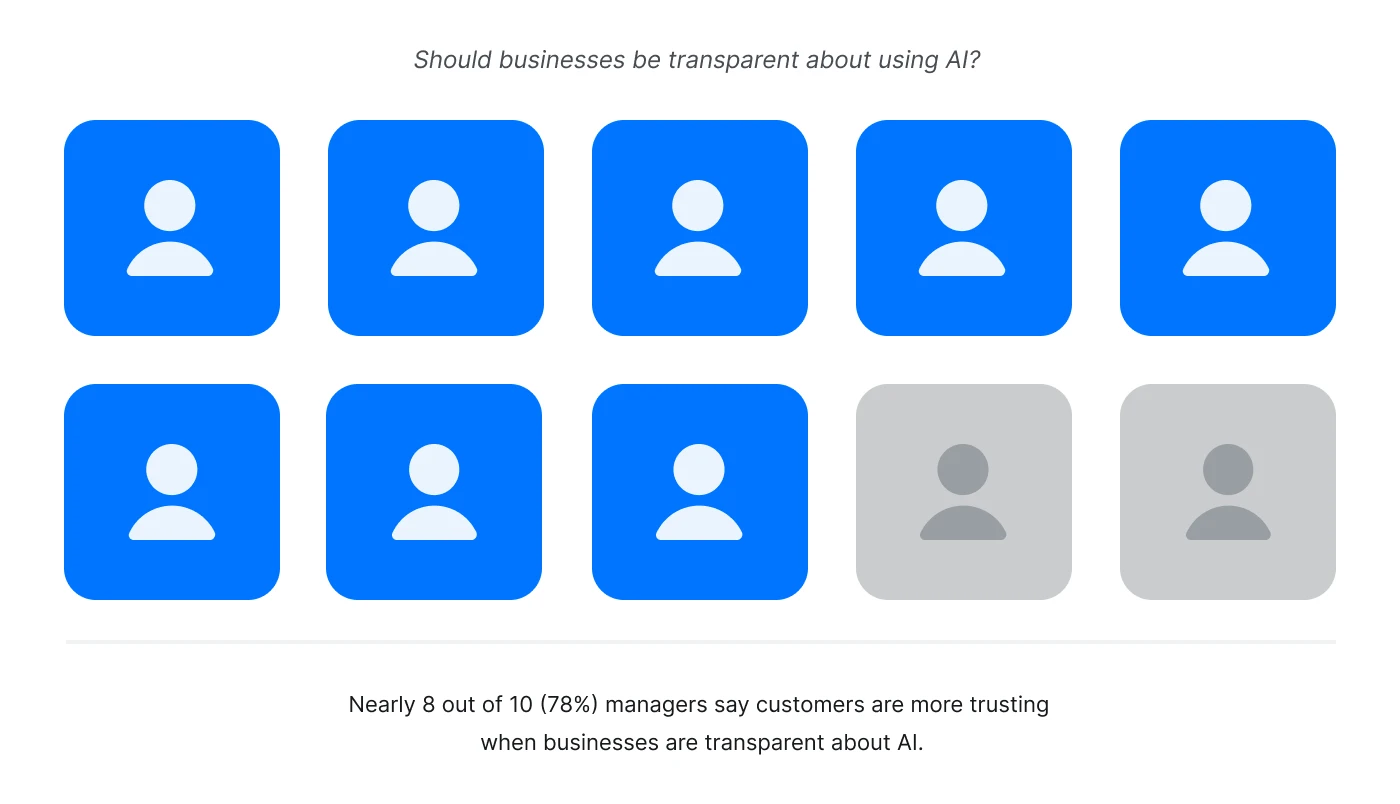
Attempting to disguise AI as a human experience is a fast way to erode trust—customers reward transparency.
Human Connection Still Drives Loyalty
However, even with transparency, managers believe there are limits to what customers will accept. A significant 68% agreed that companies that replace too much of the human touch with AI will lose long-term customer loyalty. That sentiment is reinforced by another finding: 72% believe that while customers admire innovation, they quickly lose trust when AI reduces human connection. In other words, automation can enhance a brand—but not if it comes at the expense of genuine interaction.
This fear of losing humanity in service relationships is already impacting leaders’ thinking. 62% worry their company will feel “too transactional” if AI is overused, potentially harming customer relationships and overall brand perception. This shift suggests that brands are now competing not just on speed and convenience—but on emotional experience.
For businesses, the message is clear: AI-driven service is no longer just about efficiency; it’s about brand identity. Companies must be intentional about how AI represents their values in the eyes of customers.
In the next section, we move deeper inside organizations to explore what AI means for the workforce—how employees are responding, how roles are evolving, and why AI is reshaping team structures in 2025.
Humans Still Power the Machine
AI isn’t replacing employees—it’s reshaping roles and forcing a new era of collaboration
While much of the AI conversation focuses on customer experience, the bigger story is happening inside organizations. AI is changing how teams operate, how managers lead, and how employees feel about the future of their jobs. For many companies, AI isn’t replacing work—it’s redistributing it. And that shift is creating both opportunity and tension. This section explores how managers perceive AI’s impact on employees, workplace culture, and the evolving relationship between humans and intelligent systems.
Most Managers Don’t Want to Replace Employees With AI
Despite the assumption that automation is coming for every role, few managers actually want a future where humans are removed from service work. When asked whether replacing employees with AI tools is a good thing for their company, only 36% agreed, while 40% disagreed and 24% were neutral. That means a majority of managers do not fully support AI-driven workforce reduction. This signals that, in practice, leaders aren’t convinced AI-only service is better—for either customers or company culture.
Human–AI Collaboration Is the Preferred Future
Rather than viewing AI as a replacement for people, most managers see it as a partner. A resounding 74% agreed that the best customer experiences will come from a partnership between human agents and AI agents working together, with only 9% disagreeing.
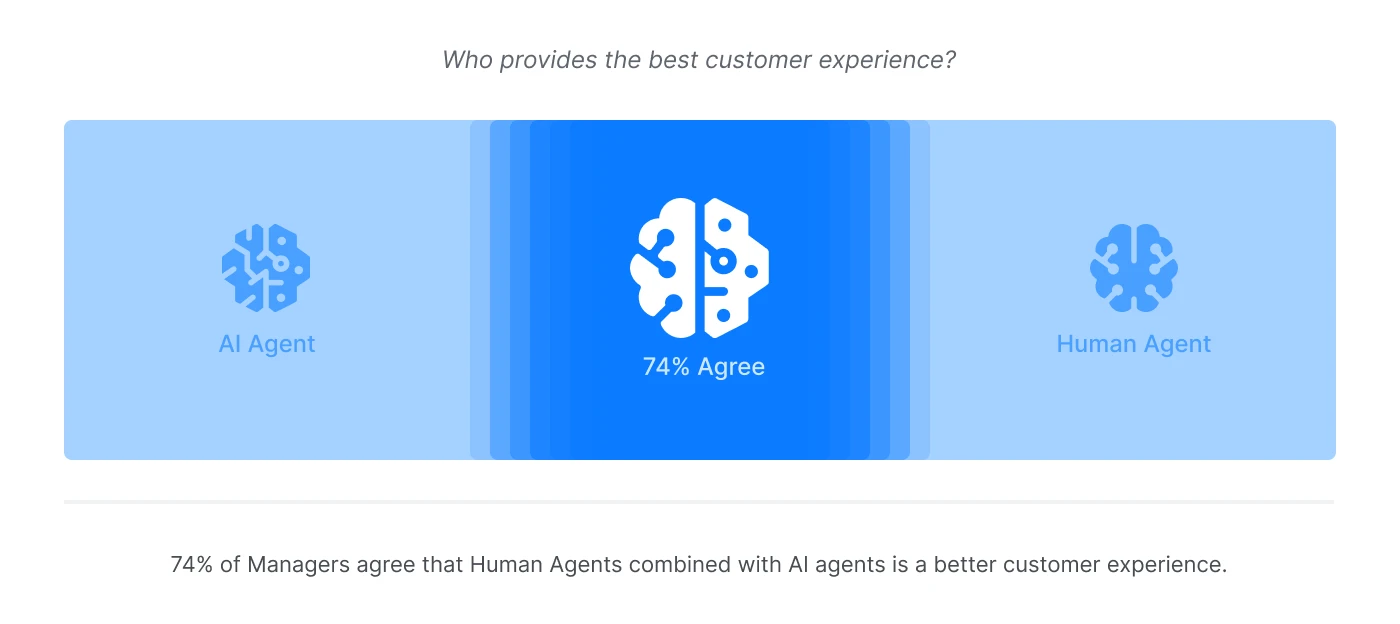
This reinforces a powerful theme from across the survey: AI is strongest when it supports people, not when it tries to replace them. Leaders believe service excellence comes from combining AI’s speed and consistency with human empathy, judgment, and creativity.
AI Doesn’t Eliminate Work—It Changes It
The promise of AI is often framed as “automation that reduces workload.” But managers working with AI every day say the opposite is happening. 79% said AI still requires significant human support hours—from training AI systems to troubleshooting customer escalations and overseeing AI accuracy. Instead of removing the need for people, AI has created new categories of work: AI supervision, quality assurance, data training, and escalation handling. This has major implications for staffing, training, and performance planning.
The internal impact of AI is not a story of replacement—it’s a story of realignment. Managers are signaling that AI adoption comes with real human requirements: training, oversight, and thoughtful collaboration. Companies that view AI as a “set it and forget it” strategy will face breakdowns in service quality and employee trust. Those that approach AI as a team member—not a team replacement—will win.
As we move forward, AI will only become more involved in business operations. The next section explores the financial implications of AI adoption—what managers really expect when it comes to cost, savings, and return on investment.
The ROI Reality Check
AI is a strategic priority—but hidden costs and unclear returns are testing business confidence
As AI moves from experimentation to implementation, business leaders are being forced to reconcile its promise with its price. While most executives believe AI is essential for long-term competitiveness, questions remain: Where will the financial value actually come from? How long will it take to see returns? And are companies prepared for the true costs of AI—beyond software licenses?
This section explores how managers view AI as an investment, where they expect gains, and the financial realities they’re encountering along the way.
AI Investment Is a Priority—Even With Rising Uncertainty
Despite economic pressure, companies are still betting on AI as a strategic advantage. 64% of managers say AI adoption is a top strategic investment for their company, even when factoring in upfront costs. Only 14% disagree.
This signals strong commitment—even among organizations still in early stages of adoption. AI is no longer treated as an optional experiment. It’s becoming budgeted infrastructure.
Productivity, Not Layoffs, Is Driving Financial Expectations
When asked where AI will provide the greatest financial benefit, managers gave a clear answer: productivity—not headcount reduction. Only 9% expect savings to come from reducing staffing needs, while a larger 31% expect gains from improved employee productivity. The next biggest expectations were lowered operational costs (18%) and faster customer service (18%), followed by better decision-making through AI-driven insights (11%).
These results reveal a key shift in mindset: AI isn’t primarily seen as a way to cut jobs—it’s seen as a way to accelerate teams and scale impact.
The Cost of AI is Higher Than Expected
AI may eventually save money—but getting there is expensive. 52% of managers said the cost of adopting AI has been higher than their company expected, including software, integrations, training, and compliance. Only 20% disagreed. For many companies, AI’s hidden costs—ongoing maintenance, human oversight, prompt engineering, AI governance, and customer escalations—are creating new budget pressures.
The financial model of AI is becoming clearer: upfront investment now, potential returns later. But those returns depend on implementation—and the ability to align AI with real business outcomes.
For companies investing in AI, the message from managers is clear: AI is no longer optional—it’s a core business investment, but it must be managed strategically. The real financial gains are expected to come from productivity improvements and operational efficiency rather than workforce reduction, signaling that AI is being used to enhance teams, not eliminate them.
However, many organizations have already found adoption costlier than expected due to ongoing needs like training, integration, and human oversight. To see meaningful ROI, businesses must align AI initiatives with real outcomes, budget for long-term implementation, and ensure AI strengthens—not disrupts—the customer and employee experience.
Conclusion & What’s Next in 2026
AI has officially moved from concept to reality in customer experience and business operations—but the path forward is not as simple as automation replacing human effort.
The findings from this survey make one thing clear: the future belongs to companies that use AI intelligently, transparently, and responsibly.
Customers want faster service, but not at the expense of trust. Employees are open to AI, but not if it replaces purpose and connection. And while leaders see AI as a strategic priority, they also recognize that meaningful results require investment, oversight, and a human-centered approach.
The most successful organizations in 2025 and beyond won’t be the ones that deploy the most AI—they’ll be the ones that deploy it well. That means integrating AI in ways that elevate service quality, empower teams, and strengthen brand credibility. AI is an accelerator, not a replacement. When paired with human judgment and empathy, it becomes a powerful force for growth.
The real competitive advantage isn’t AI alone—it’s AI with clarity, direction, and trust.
Methodology
All data found within this report is derived from a survey by Vida.io conducted online via the survey platform Pollfish in October 2025. In total, 2,000 American managers were surveyed. The respondents were found via Pollfish’s age and organizational role filtering features. This survey was conducted over a five-day span, and all respondents were asked to answer all questions as truthfully as possible and to the best of their knowledge and abilities.